











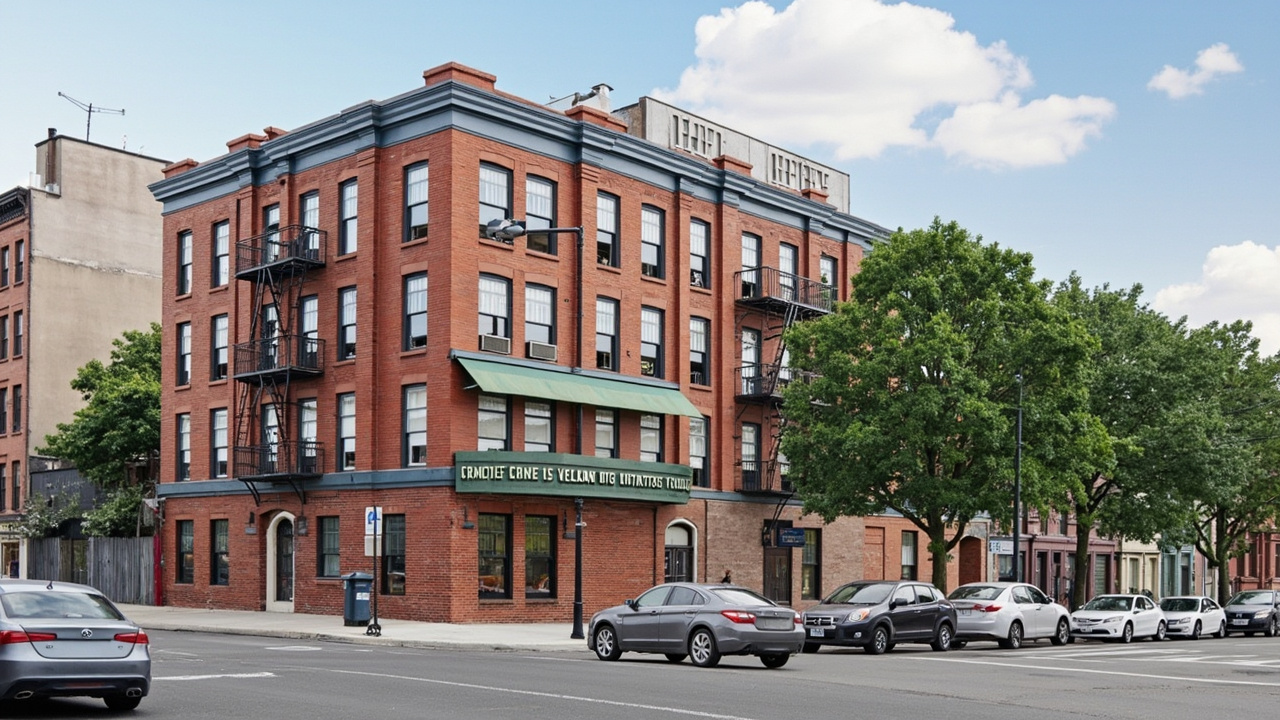

Ariel Property Advisors has closed the sale of a major corner development site in Prospect Heights, giving Haussmann Development an early position in Brooklyn’s changing Atlantic Avenue corridor.
The $21 million transaction covers 566 Grand Avenue and 836 Dean Street. The approximately 86,065 buildable-square-foot site changed hands for roughly $244 per buildable square foot and sits within the Atlantic Avenue Mixed-Use Plan, approved in May 2025 to facilitate 4,600 new homes.
Scale changes the development equation
For Haussmann, the attraction is not simply the address or the reported land basis. The buyer is acquiring a substantial corner parcel within a corridor where rezoning has opened a visible pipeline of residential development opportunities.
Scale can be valuable when a sponsor is assembling a project large enough to support several uses or construction phases. It may also spread certain fixed costs across more floor area. A corner location can strengthen a project’s visibility and market position, but it can also increase the complexity of how the site is designed and delivered.
The transaction therefore represents more than a land purchase. It is an early bet on how a sizeable site can be turned into a viable project after design, approvals, financing and construction are considered. A favorable zoning framework can create opportunity, but it does not determine the final return.
Ariel represented the long-term owner, with partner Sean R. Kelly and Nicole Daniggelis and Stephen Vorvolakos arranging the transaction. Haussmann Development, led by Josef Goodman and Jake Sokol, acquired the property.
The $244 benchmark starts a larger underwriting exercise
The reported $244 per buildable square foot offers a useful entry point for comparing the deal, but it is not a complete measure of value. Investors still need to test the permitted program, the site’s requirements and the capital needed to carry the project through completion.
| What is known about the sale | Why it matters | What still needs testing |
|---|---|---|
| The site sold for $21 million | Establishes the buyer’s basis before development costs | Whether the basis supports an attractive return after construction and financing |
| Approximately 86,065 buildable square feet | Provides scale at a prominent corner location | How that scale translates into the final development program |
| The price was approximately $244 per buildable square foot | Creates a benchmark for future land comparisons | Whether comparable Atlantic Avenue sites trade at similar levels |
| The property is within the Atlantic Avenue Mixed-Use Plan | Places the acquisition within a corridor targeting 4,600 new homes | How new supply affects the corridor’s residential and supporting uses |
| Ariel represented the long-term owner | Provides transaction context without establishing development terms | The design, approval path, construction schedule and financing structure |
Other land sales within the Atlantic Avenue Mixed-Use Plan could make this transaction easier to evaluate. A similar price for a parcel with comparable zoning and scale would offer stronger evidence that $244 per buildable square foot reflects market pricing. A meaningful premium or discount would raise other questions about the respective sites and their development paths.
That comparison is especially important because no single land-price figure captures the full economics. A sponsor may pay more per buildable foot for certainty of approvals or a more straightforward program, or less when a parcel requires more difficult work. Without comparable terms, the reported basis should be treated as a starting point rather than a verdict on the corridor.
Why Haussmann may be buying early
Haussmann’s advantage is access to scale before the surrounding development pipeline is fully realized. The Atlantic Avenue plan creates the possibility of sustained construction, new residents and demand for supporting uses. Being among the early sites in that pipeline could position the buyer to benefit if the corridor continues to attract development interest.
That advantage comes with exposure. A large project is more sensitive to cost changes, financing conditions and delays. Residential development also depends on how quickly completed units can be sold or leased at prices that support the sponsor’s underwriting. If the final program includes commercial or other nonresidential space, those components would require additional leasing and execution decisions.
The buyer also receives whatever comes with the parcel. A long-term owner may have a particular view of the property’s condition, history or potential, but the available facts do not establish why the seller decided to exit or what specific terms shaped the negotiations. The sale confirms a change in ownership; it does not, by itself, prove that every element of the site presents an uncomplicated path forward.
For Haussmann, the wager is that early scale and a visible corner position can compensate for the uncertainty attached to developing a major site. For investors, the relevant question is whether that wager becomes more or less credible as the program and timetable emerge.
Who wins—and what could disrupt the thesis
Haussmann benefits if the site’s scale, location and zoning context prove more valuable than the acquisition cost suggests. The seller benefits from monetizing a long-held asset at a point when the corridor’s residential potential is drawing attention. Neighbors and future residents could benefit if successful construction adds housing and supporting uses to an established area.
The trade-off is that the plan’s 4,600-home objective creates both opportunity and competition. A larger pipeline can reinforce the corridor as an active development market, but it can also introduce substantial future supply. That makes execution quality important: a well-delivered project could establish demand, while delays, weak absorption or rising costs would test the assumptions behind early land purchases.
The next useful evidence should come from Haussmann’s design plans, permit applications, financing arrangements and construction schedule. Those steps would reveal how the buyer intends to convert the $21 million basis into a workable project. Other transactions within the plan would provide an additional check on whether this price reflects a broad market trend or an early premium attached to this particular corner site.
Key takeaways
- The $21 million sale gives Haussmann a large corner position within a major Brooklyn rezoning corridor.
- At approximately $244 per buildable square foot, the price is a benchmark rather than a complete valuation.
- The central investment question is whether scale and early corridor access outweigh approval, construction, financing and absorption risk.
- Design plans, permit filings, financing and comparable land sales will provide the clearest test of the transaction’s pricing.
Frequently asked questions
Who bought the Prospect Heights development site?
Haussmann Development, led by Josef Goodman and Jake Sokol, acquired the property.
How much land was included in the sale?
The corner site comprised approximately 86,065 buildable square feet.
What was the sale price per buildable square foot?
The reported price was approximately $244 per buildable square foot.
When was the Atlantic Avenue Mixed-Use Plan approved?
It was approved in May 2025 with the goal of facilitating 4,600 new homes.

