



















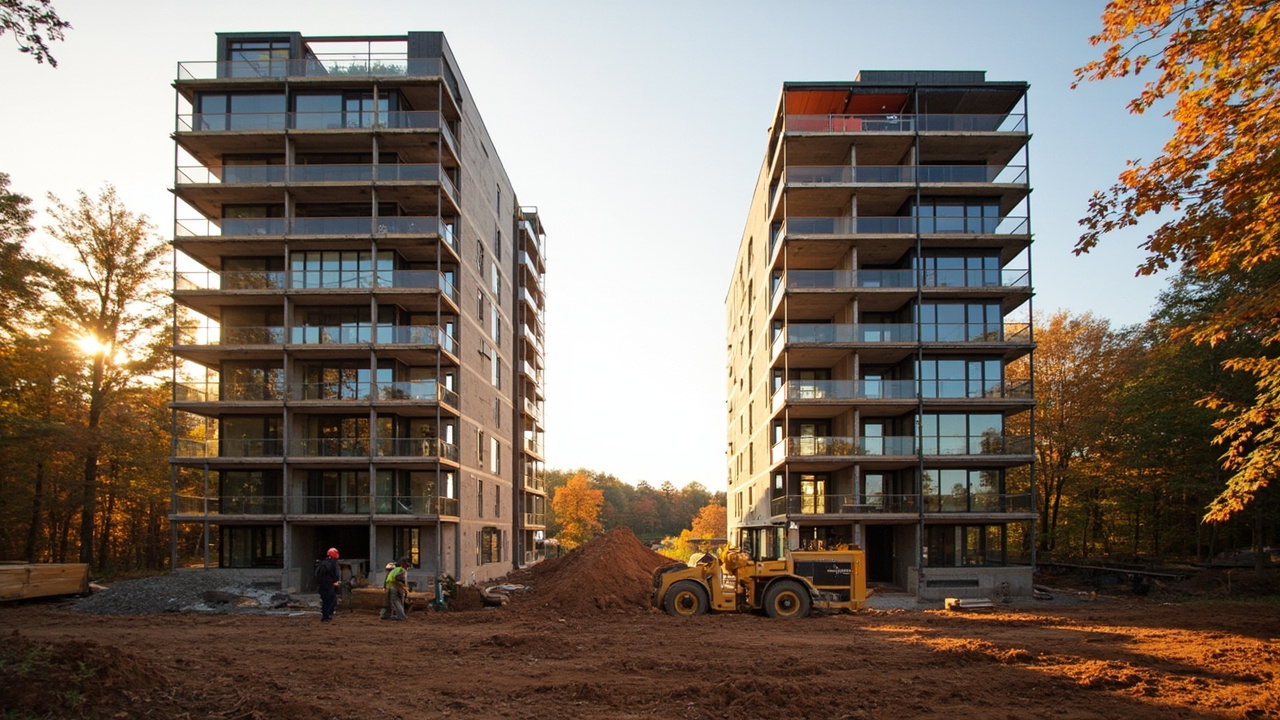


Two separate ground-breaking ceremonies in Concord, Massachusetts, have added a combined pipeline approaching 440 multifamily units to the Greater Boston development landscape. The projects differ in scale, design philosophy, and the investors behind them, but both are targeting the same under-supplied suburban submarket and both are setting aside a quarter of their homes as affordable.
Which builder is betting on Passive House certification and resort-style amenities? Which has institutional retirement capital behind it? And what does this twin pipeline mean for investors watching suburban Boston? Here is what we know.
The Players and the Numbers
According to Connect Commercial Real Estate, L&G's U.S. Asset Management business and Taurus Investment Holdings broke ground on a two-building community at 292–294 Baker Ave. The investment is being made on behalf of L&G's Institutional Retirement business, marking the first funding of a new U.S. Development for that unit. The partnership has prior multifamily experience through The Alder near Denver and Arkadia West Loop in Chicago.
PRNewswire reported that Wood Partners simultaneously broke ground on Alta Thoreau, a 237-unit development at 265 and 269 Forest Ridge Road. That project is scheduled to complete in February 2028, with two five-story residential buildings offering one-, two-, and three-bedroom homes. Operating from Atlanta, the firm maintains offices in 17 major markets, holds a top-five ranking among U.S. Multifamily developers, and currently has eight projects operating in Massachusetts.
The short version
- L&G/Taurus: 201 units at Baker Ave., Concord, MA; completion targeted end of 2028 for first building, 2029 for second
- Wood Partners: 237 units at Forest Ridge Road, Concord, MA; targeted completion February 2028
- Each development sets aside a quarter of its units as affordable, using the state's Chapter 40B program
- Both developers cite structurally undersupplied conditions in the Concord submarket
- L&G/Taurus represents institutional retirement capital; Wood Partners is a national top-five developer
Why Concord?
Neither announcement would land without context: Concord sits roughly 20 miles northwest of Boston and has historically resisted dense residential development. That resistance has created a supply vacuum. The town is described as structurally undersupplied — meaning even normal household formation pressures cannot easily find product, let alone an investment-grade flow of new units.
For commercial real estate investors, undersupplied suburban submarkets carry specific appeal. Cap rates in these locations tend to be more stable than in core urban cores, where new supply pipelines can swing vacancy rates sharply. Leasing risk is lower when absorption is essentially guaranteed by demographics and a proven demand-supply imbalance.
Both developers are also threading the affordable housing needle through Chapter 40B, Massachusetts's affordable housing statute. This mechanism allows developers to bypass certain local zoning obstacles by including a defined share of income-restricted units. It is a common play in Massachusetts suburban development and one that sophisticated investors will recognize as a political risk-mitigation tool as much as a community benefit.
Our Analysis: Different Strategies, Same Thesis
Here is the interesting part. Two completely unrelated development teams have independently concluded that Concord, MA is the right place to put institutional capital to work. That convergence is not coincidence — it reflects a macro signal that suburban multifamily near Boston has moved onto the radar of both domestic institutional allocators and national private developers.
The strategies diverge sharply once you scratch the surface. L&G and Taurus are deploying retirement-related capital, which tends to prioritize stable, longer-horizon income streams. A suburban asset with institutional backing and a defined affordable component fits that profile cleanly. The two-building, phased completion approach — first building end of 2028, second in 2029 — also suggests a leasing absorption plan rather than a big-bang delivery.
Wood Partners, by contrast, is playing a more differentiated game. Alta Thoreau is designed to Passive House standards, runs entirely on electric power, and includes porous pavement and a full slate of lifestyle amenities including a golf simulator and pet spa. This is not a yield play — it is a product differentiation play targeting a demographic that will pay premium rents for sustainability credentials and lifestyle features. The Passive House angle is particularly notable: it is still relatively rare in Massachusetts multifamily, which gives the asset a potential marketing edge as energy costs rise and renters grow more climate-conscious.
The timing question is real. PRNewswire's release is dated September 8, 2026. Connect's report references construction beginning "THIS YEAR" but does not provide an exact ceremony date. It is possible the L&G/Taurus groundbreaking either preceded or will follow the Wood Partners event. Either way, Concord is absorbing two significant additions to its housing stock within a compressed window.
What It Means for You
Say you are an investor evaluating a direct multifamily acquisition in the Greater Boston suburbs, or you are weighing a REIT with exposure to that corridor. The immediate takeaway is that supply pressure in Concord is about to increase meaningfully. Units hitting the market in 2028–2029 will test absorption capacity, even in an undersupplied submarket.
Watch first-year lease-up velocity on both projects. If Alta Thoreau achieves above-market rents on the strength of Passive House certification and premium amenities, it validates the sustainability premium thesis in suburban Boston. If L&G/Taurus maintains steady occupancy from day one, it reinforces the case for institutional-grade suburban multifamily as a low-risk income vehicle.
Watch the Chapter 40B component. Both projects lean on this mechanism. Any change to Massachusetts affordable housing policy — or local resistance to future 40B filings — would directly affect the development economics of the Concord submarket.
Watch for further L&G U.S. Institutional development activity. The Taurus partnership represents a new geographic mandate for that capital pool. If this first deal performs, expect follow-on deployments.
Bottom Line
Concord is getting more multifamily than it has seen in years, from two builders with very different playbooks. For investors tracking the Boston suburban corridor, these breakgrounds confirm that institutional capital and national development expertise are converging on the same thesis: undersupplied suburban submarkets near major metros still offer viable risk-adjusted returns in 2026. Whether the end product is a sustainability showcase or a retirement-grade income vehicle, the underlying demand story holds.
Watch next for completion announcements and initial leasing data. The first months of absorption will tell you whether Concord's demand is as solid as both developers are betting.
Key takeaways
- Concord, MA is absorbing two significant multifamily developments, each with institutional backing and a national development pedigree
- The projects use different strategies: institutional retirement capital (L&G/Taurus) vs. Lifestyle/sustainability differentiation (Wood Partners)
- Both rely on Massachusetts Chapter 40B for affordable housing, a key political variable to monitor
- Suburban Boston multifamily remains attractive to both domestic institutional allocators and national developers
- Lease-up performance in 2028–2029 will test whether the submarket can absorb this pipeline without cap rate pressure
Frequently asked questions
Where exactly are these two projects located in Concord, MA?
The L&G/Taurus development is at 292–294 Baker Ave. The Wood Partners project, called Alta Thoreau, is at 265 and 269 Forest Ridge Road. Both are in Concord, approximately 20 miles northwest of Boston.
How many affordable housing units are included in each project?
Each project dedicates 25% of its units as affordable under Massachusetts Chapter 40B. The specific income-tier breakdowns would be confirmed in each project's regulatory filings.
When will the new units be ready to lease?
Wood Partners targets completion for February 2028. L&G/Taurus expects the first building ready by end of 2028, with the second building following in 2029.
Is Passive House certification common for multifamily in Massachusetts?
No. Wood Partners' Alta Thoreau is described as the company's first Passive House-designed community in Massachusetts, making it a relatively rare specification in the local market. That rarity could become a marketing differentiator if energy costs rise.
Who is backing the L&G/Taurus project?
The capital comes from L&G's Institutional Retirement business in the U.S., managed through its Asset Management division, with Taurus Investment Holdings as the development partner. The announcement explicitly describes this as the first new development funding in the U.S. For L&G's Institutional Retirement unit.