



















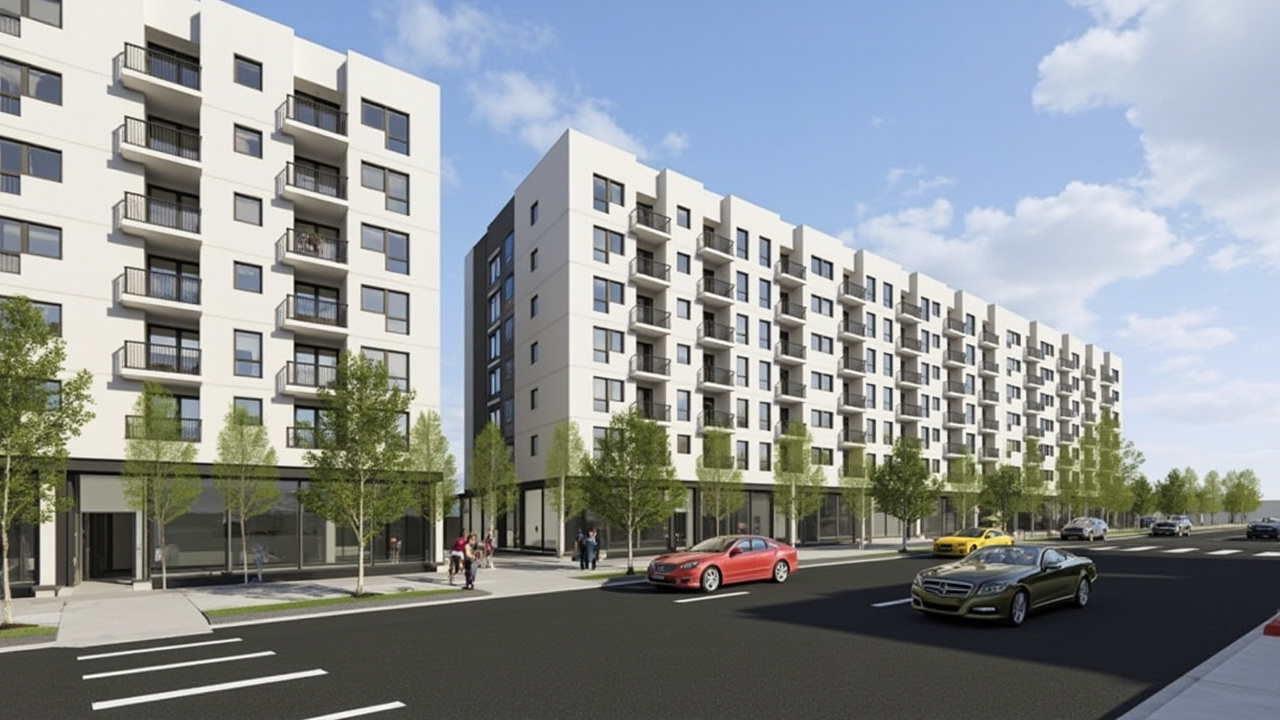


A joint venture between Slate Property Group, Hudson Companies and Volunteers of America will develop approximately 980 apartments on a vacant city-owned parcel in Long Island City, Queens. Two-thirds of the units will be income-restricted, including around 150 supportive apartments. Construction is slated for the 30-acre Hunter's Point South complex at 54-42 Second Street, where the city has been rolling out one of New York's most ambitious mixed-income housing blueprints.
The Department of Housing Preservation and Development issued a request for proposals for Parcel E last June, with the explicit condition that the selected project include a greater share of affordable units than prior phases. The Orion won the competitive selection process, according to commercialobserver.com.
What's Being Built at Parcel E
The development covers just over 70,000 square feet and will feature ground-floor retail along Second Street and Center Boulevard, approximately 6,000 square feet of commercial space. Amenities include an affordable child care center, a workforce development facility and a community pool.
Marvel Architects designed the mixed-use community. The 658 income-restricted apartments will serve households earning between extremely low and moderate incomes.
In a press statement, Slate Property Group principal David Schwartz described the initiative as precisely what the city requires, noting his firm was ready to move to site work pending city approvals.
Why This Matters for Commercial Real Estate Investors
Hunter's Point South has become a test case for how public-private partnerships deliver scale in dense urban corridors. Parcel E marks the sixth of seven parcels slated for development, following extensive work by TF Cornerstone, whose Malt Drive mixed-use project forms the backbone of the existing community.
For investors tracking urban mixed-use pipelines, the structure of these deals matters. Developers gain site control through city RFPs, which impose affordability mandates and community benefit requirements that constrain yield. That tradeoff has historically limited institutional capital's appetite for purely affordable projects, yet the inclusion of market-rate units and commercial density helps bridge the gap.
The Orion's approval signals continued municipal appetite for deeply subsidized housing within larger mixed-income schemes. That matters for commercial readers because the same infrastructure—schools, retail, transit-adjacent land—underpins the market-rate portion of these projects. When the city delivers affordable units at scale, it stabilizes the broader tenant base that supports retail and commercial occupancy downstream.
The 6,000 square feet of ground-floor retail attached to this project is modest, but it adds to a growing commercial corridor in Hunter's Point. Investors with exposure to that submarket should track absorption rates there. If commercial retail vacancy stays low as residential density increases, that reinforces the case for valuing ground-floor space within mixed-use envelopes.
What is less certain is whether the supportive housing component—150 units—will draw dedicated social service funding or rely on operating subsidies embedded in the deal structure. That distinction affects long-term net operating income projections.
A Worked Example for Readers
Say you are evaluating a mixed-use property nearby that includes market-rate apartments and ground-floor retail. With the Orion adding nearly a thousand households within walking distance, foot traffic to local amenities should increase. If your property's retail lease expires within two years, this density shift is a data point when modeling rent escalation assumptions. Comparable leases in the area may adjust upward as consumer spending power in the immediate catchment grows.
What to Watch Next
Watch for the final developer selected for Parcel G—the seventh and last parcel at Hunter's Point South. That selection will complete the city's master plan and determine whether the remaining affordability requirements tighten further or allow more market-rate balance. Also monitor construction timelines: any delays to the Orion's groundbreaking could affect the timeline for the broader infrastructure assumptions that nearby investors rely on.
Bottom line:** The Orion is a moderate-scale urban infill win for affordable housing advocates and a net positive for neighborhood retail fundamentals in Hunter's Point South. Institutional investors with nearby commercial exposure should factor the added residential density into long-term occupancy and rent forecasts.
Key takeaways
- Parcel E's approval adds nearly 1,000 units and 6,000 sq ft of retail to a maturing mixed-use district, reinforcing commercial viability of the Hunter's Point South corridor.
- The 658 income-restricted units are mandated by the city's RFP structure, meaning developers accepted lower yields in exchange for site control and subsidized financing.
- Nearby commercial property investors should monitor retail absorption and lease-up rates as residential density ramps up over the next several years.
- The supportive housing component requires clarity on operating subsidies before investors can model stabilized NOI accurately.
Frequently asked questions
How many units at the Orion will be designated as affordable housing?
Approximately 658 of the 980 apartments—roughly two-thirds—will be income-restricted, affordable to extremely low- through moderate-income households. Around 150 of those will serve as supportive units.
Who are the developers behind the Orion project?
Slate Property Group, Hudson Companies and Volunteers of America form the development team. The project was selected through a city RFP process run by the Department of Housing Preservation and Development.
What commercial amenities are included in the development?
The project includes roughly 6,000 square feet of ground-floor retail along Second Street and Center Boulevard, an affordable child care center, a workforce development center and a community pool.
Where is the Orion located?
The development sits at 54-42 Second Street in Long Island City, Queens, within the Hunter's Point South housing complex.
How does this fit into the broader Hunter's Point South plan?
Parcel E is the sixth of seven parcels designated for development at Hunter's Point South. When complete, the full complex will feature approximately 5,000 new homes, roughly 3,000 of which will be affordable.